Crucial Conversations
The Standard in Effective Communication: Crucial Conversations skills represent the standard in effective communication and the marker of high performance individuals and organizations.
We transform leaders, teams, and organizations. Our proven programs, tools, and ongoing support drive real change.
Beyond theory, a methodology that drives real change. Tools that can be applied immediately to lead better, work smarter, and deliver measurable impact.
The Standard in Effective Communication: Crucial Conversations skills represent the standard in effective communication and the marker of high performance individuals and organizations.
Stress-Free Productivity: Getting Things Done teaches skills that enhance focus and productivity while reducing stress and burnout.
Performance Management Improved: Gain skills to confront, discuss, and resolve problems of poor performance, bad behavior, and violated expectations with Crucial Conversations for Accountability.
Leadership Training: Leadership skills that are essential for leaders at every level of the organization—from new managers to top executives.
If your organization needs to develop other key skills or address unique challenges, we’ll design a program tailored to you—backed by diagnostics, proven methods, and ongoing support.
Proven results from real professionals
"Crucial Conversations training has two positive readings. A unanimous demand from the participants, and a direct effect on improving the organization's workplace indicators"
"Their Crucial Conversations sessions are impactful, practical, and delivered with real depth and care. They bring strong content and connect with people in a way that drives real change. They do exactly that!"
"The Crucial Conversations program has equipped participants with key skills for effective dialogue. It provides insights and tools to handle difficult conversations with confidence, turning conflicts into opportunities to strengthen relationships and improve results."
Combine world-class programs, diagnostics, and full support implementation to guarantee real behavior change and lasting results.
See what drives your teams. Use SDI 2.0 and our custom platforms to uncover motivation, conflict styles, and performance gaps
Why This?
Skills that last. Our Crucial Learning and custom Programs give leaders tools they apply the following day.
Why This?
Turn new skills into lasting habits. Coaching, workshops, and tailored support make behavior change part of your culture Operating System.
Why This?
Stay up to date with the latest trends in corporate training and leadership development.
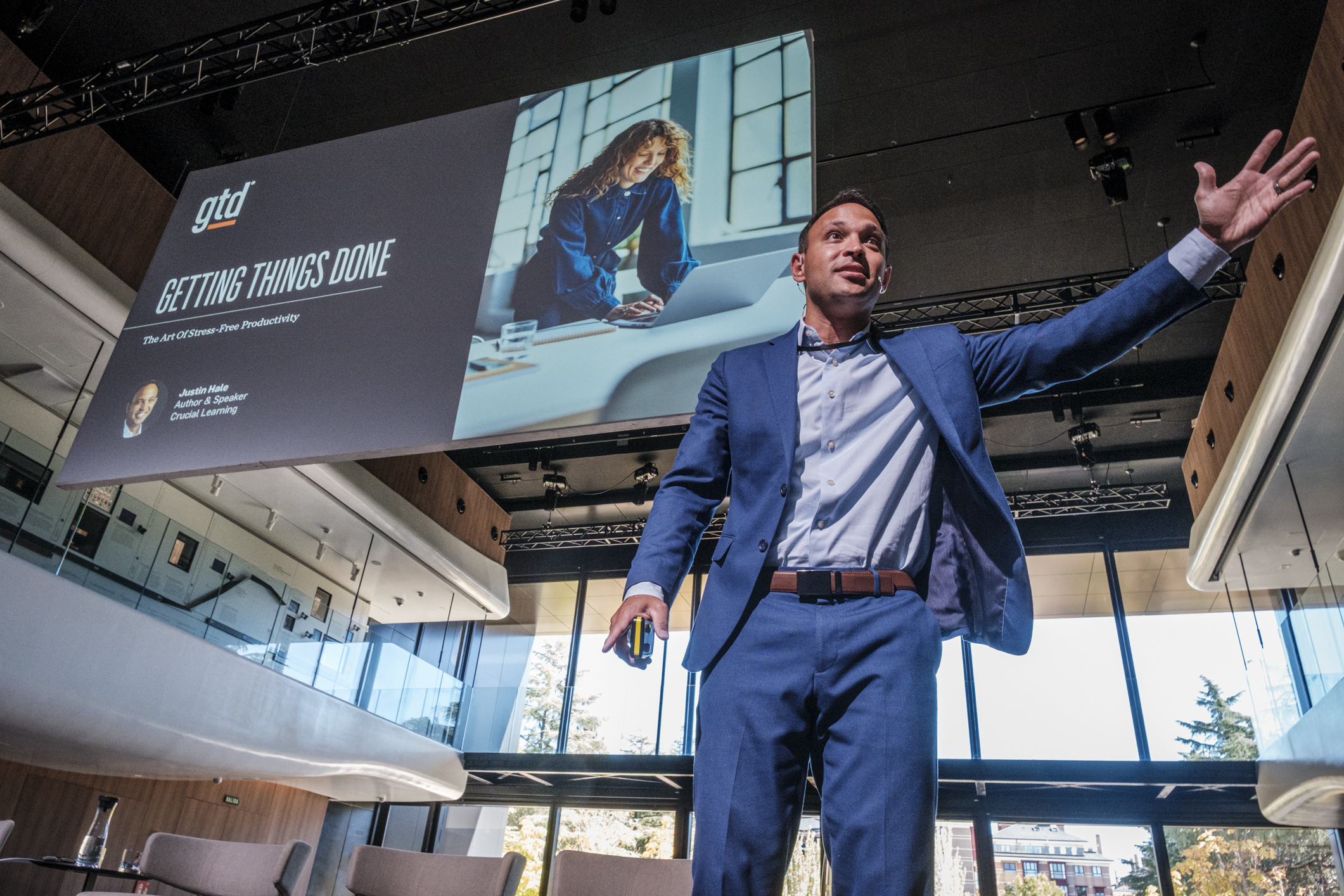
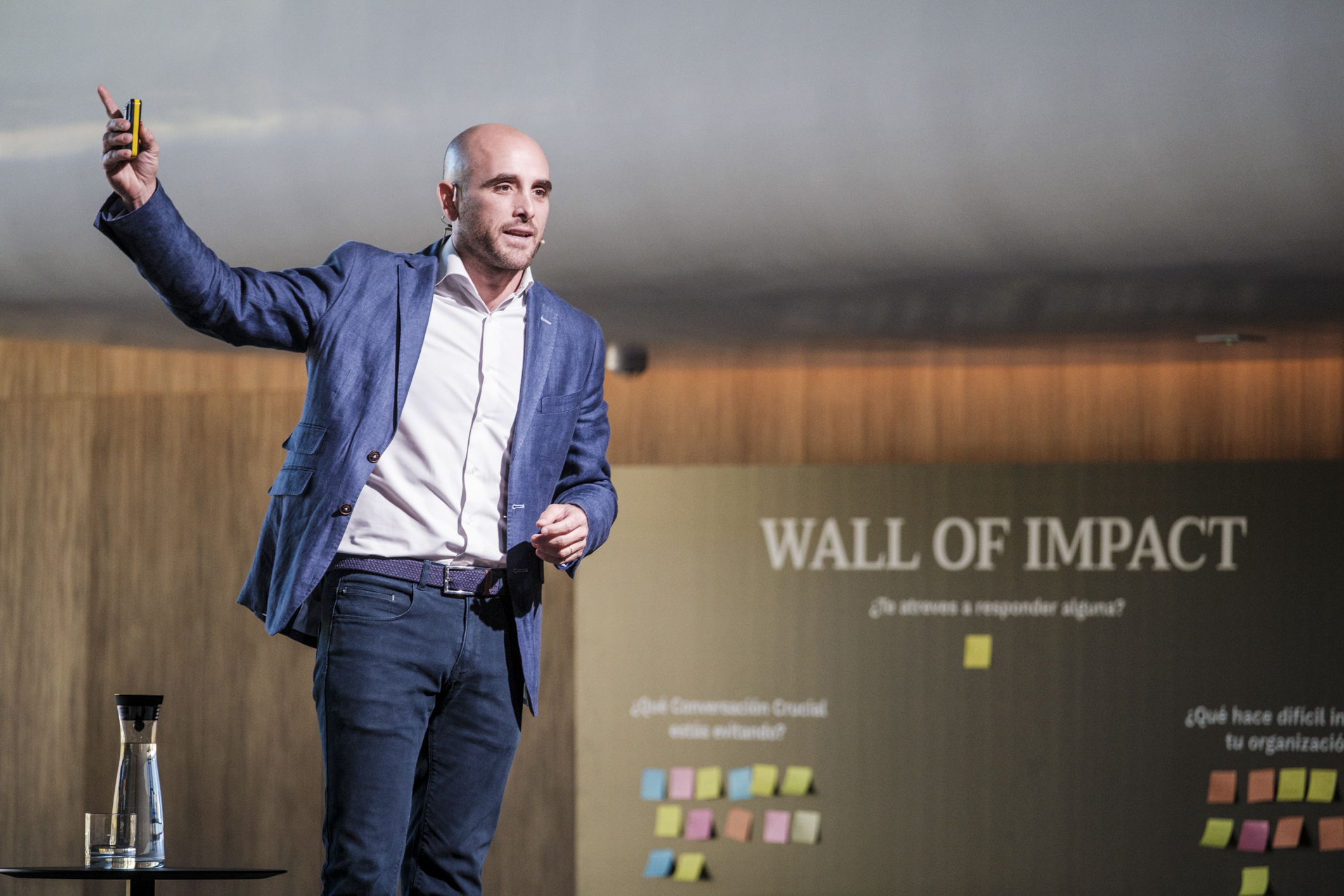
Unread emails, endless meetings, shifting priorities, and never-ending to-do lists. These are daily scenes in many organizations, where information overload and a lack of focus ultimately undermine the performance and well-being of both professionals and teams. This was the warning from Justin Hale, a productivity and Getting Things Done (GTD) expert, during his presentation at the Crucial Impact Summit Madrid, an event organized by Ackermann Labs, a training and skills development consultancy within the Ackermann Group.The Challenge of Achieving Results Without BurnoutDrawing on findings from over three decades of research, Hale explained that the average professional receives "about 300 pieces of content daily—audios, messages, notes—plus approximately 121 emails and 34 gigabytes of information." According to the expert, this overload causes "most professionals to have hundreds or thousands of unprocessed emails in their inboxes."For Hale, the key is not having more time, but acquiring better skills: "It’s easy to work all day and all night to get things done; the hard part is figuring out how to do the right things without getting so stressed that you no longer want to keep working. If you had 26 hours instead of 24, you would spend those two extra hours the same way you spend the others. You need better skills, not more time."The Five ‘Diseases’ of ProductivityDuring his presentation, Hale identified the five major productivity problems that cause workplace stress:Too much to do: “The volume of tasks is overwhelming me. I have too much on my plate.”Disorganization: “I’m disorganized. I can’t find what I need. I have a hundred sticky notes and I don’t know where I put that specific task. I’m always looking for the perfect productivity app… and I still haven’t found it.”Excessive meetings: “I don’t work; I just go to meetings.”Being busy but not productive: “I start the day with a beautiful to-do list and all the motivation in the world… but then an emergency arises, a call, something unexpected… and by the end of the day, I’m exhausted, I look at my list, and nothing is done.”Work-life imbalance: “At work, I think about personal things. At home, I think about work. I’m never truly present.”“We start everything but finish nothing. And our organizations don’t pay us to start things; they pay us to finish them,” he noted. In this regard, Hale emphasized that the most organized and productive people are "two to three times more valuable to their teams than the average employee," and therefore, acquiring the right skills "makes a significant difference in both personal and collective performance."Key Principles of the GTD MethodThe specialist presented the steps of the GTD model—capture, clarify, organize, reflect, and engage—as the foundation for sustainable, stress-free productivity:Capture: “Gather everything that demands your attention. But do it intentionally, not by accident. If you have five inboxes, three notebooks, and four note-taking apps, you will lose things. You need a few key places.”Clarify: “People don’t procrastinate because of a lack of time, but because of a lack of clarity. If you clearly define what the next action is, you can start moving forward.”Organize: “Many people use their calendar as a dumping ground for tasks, which leads to saturation. Use the calendar for only three things: time-specific actions, day-specific actions, and day-specific information.”Reflect and Engage: “Take time to review your priorities before jumping into action. The most effective people spend one hour a week reviewing, cleaning up, and prioritizing. It is the most powerful productivity habit.”Your Mind is for Having Ideas, Not Holding ThemOne of the greatest handicaps to our productivity, beyond the excess of unfocused tasks, is that our mind is not a hard drive: “The human mind is made for thinking, creating, and focusing, not for storing tasks. The brain was designed to forget what we have already finished; that’s why constantly remembering pending items is a source of stress and a drain on focus. When you clear your mind—by capturing everything outside of it—you can focus and perform better. No matter the task: if your mind is clear, your performance, quality, and satisfaction go up.”From Vague Projects to Concrete ActionsAmong his practical recommendations for achieving results without burning out, the expert pointed out the importance of transforming vague projects into concrete actions: “You don’t do projects; you execute small actions that lead to a result. If you only write ‘Project X,’ you won’t know where to start. Instead, ask yourself: what is the next physical, concrete, and visible action I can take? The more concrete your task list is, the easier it will be to prioritize.”Context as a Task Classification MethodA single list with an endless enumeration of tasks is another major enemy of productivity. Instead, the expert advised classifying by context or tool: calls, at home, office, computer, errands, agendas... “This way, you reduce search time and increase action time. If you have 15 minutes free, you open your calls list, pick one, and you’re done. Less scrolling through infinite lists, more doing,” he concluded.Productivity with PurposeIn the final part of his talk, Hale summarized the philosophy of Getting Things Done: “The difference between being busy and being productive lies in how we relate to our tasks. GTD is not just about doing more, but about doing more of what matters.” The expert concluded that this approach “provides freedom: the freedom to focus, and to consciously decide what to say yes to and what to say no to.”
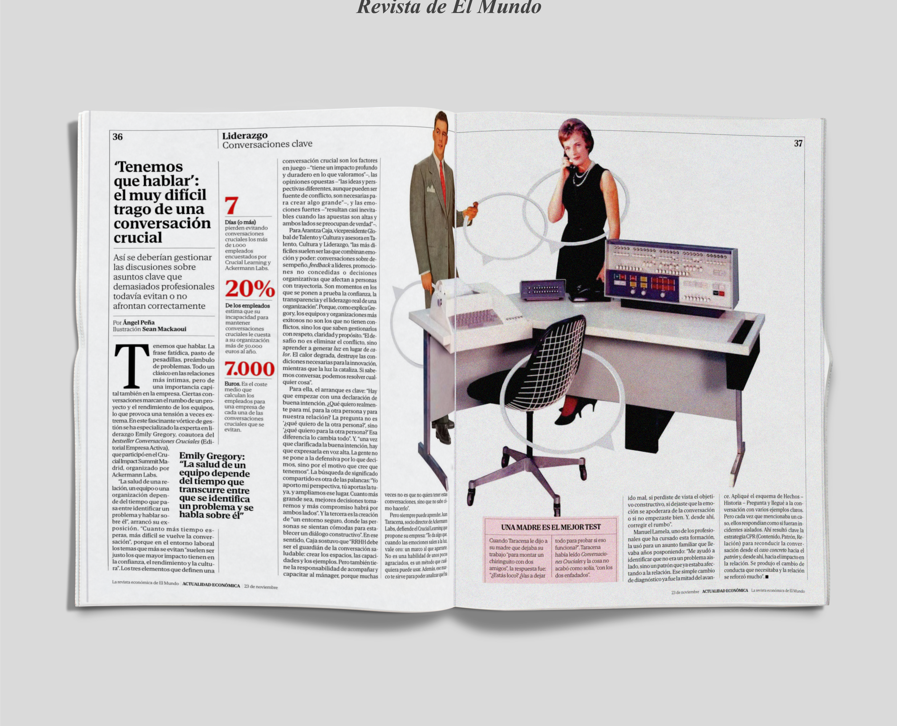
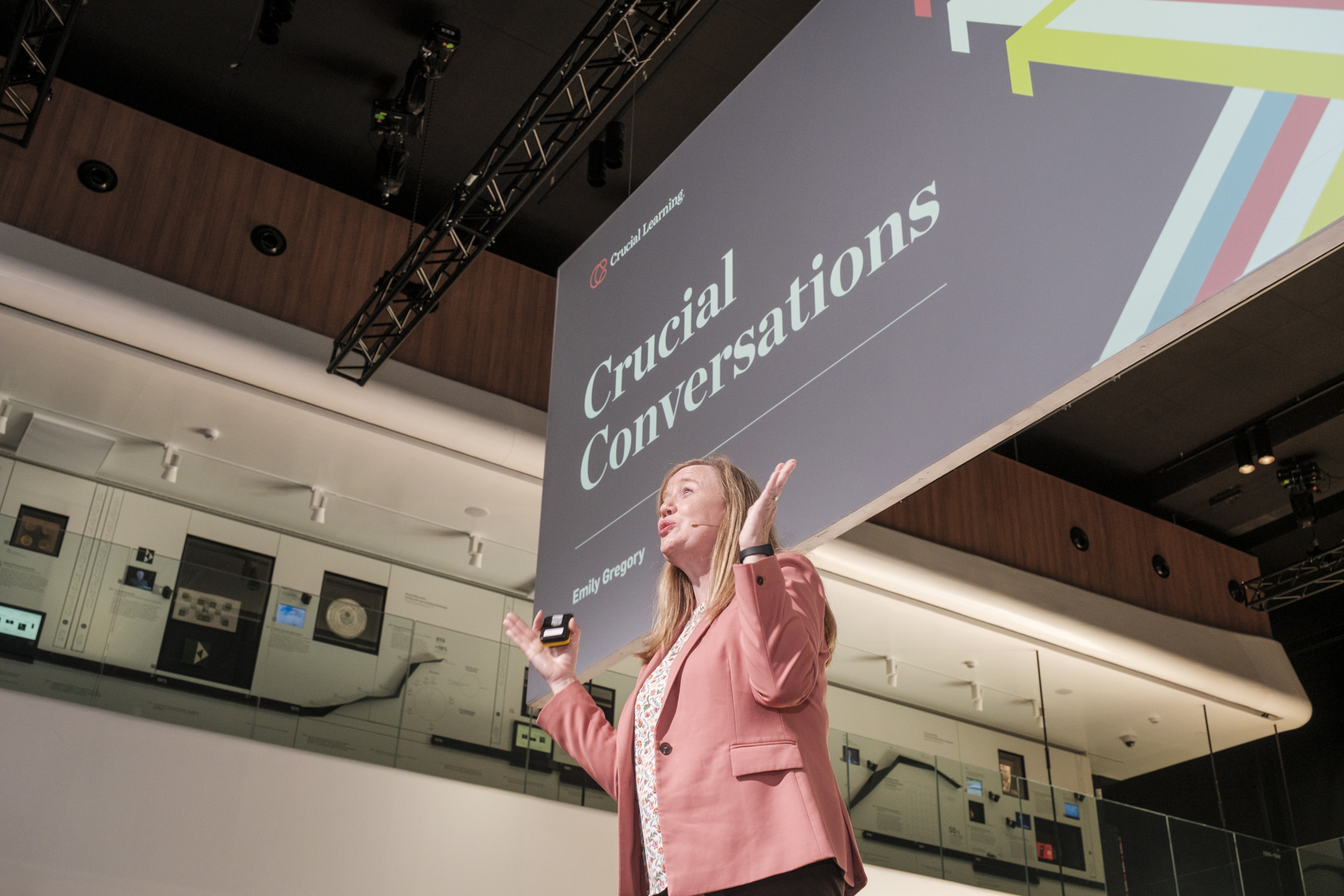
Meetings where no one dares to point out the obvious error, decisions delayed because no one wants to confront the issue, evaluations where important facts are withheld for fear of causing discomfort… these are situations experienced more frequently than desired in many teams and organizations. These moments lead to difficult conversations that not everyone is willing to face, yet they ultimately define the course of a project and the performance of a team. Leadership expert Emily Gregory, co-author of the bestseller Crucial Conversations, highlighted this during her participation in the Crucial Impact Summit Madrid, an event organized by Ackermann Labs—the training and skills development consultancy of the Ackermann Group. “The health of a relationship, a team, or an organization depends on the time that elapses between identifying a problem and talking about it. The longer you wait, the harder the conversation becomes,” she stated. According to Gregory, the topics most often avoided in the workplace are usually those with the greatest impact on trust, performance, and culture.The Power of Conversations That MatterThe expert began her presentation by defining the three elements that characterize a Crucial Conversation:High Stakes: “These are important conversations that have a deep and lasting impact on what we value.”Opposing Opinions: “The existence of different ideas and perspectives, while potentially a source of conflict, is necessary to create something great.”Strong Emotions: “It is almost inevitable that when the stakes are high and both sides truly care, strong emotions will come into play.”When Silence Becomes the Real ProblemGregory emphasized that in many companies, the biggest problems do not stem from mistakes, but from silence. She shared data from a survey conducted by Crucial Learning and Ackermann Labs, revealing that one in two workers admits to having difficult situations that worry them but remain unaddressed for weeks or months. “More than half of professionals admit to staying silent about important concerns for fear of the consequences. But what is not talked about does not disappear: a lack of honest communication often leads us to act in unhelpful—and sometimes even passive-aggressive—ways.”Keys to an Effective Crucial ConversationThe expert noted that the most successful teams and organizations are not those without conflict, but those that know how to manage it with respect, clarity, and purpose. “The challenge is not to eliminate conflict, but to learn how to generate ‘light’ instead of ‘heat.’ Heat degrades and destroys the conditions necessary for innovation, while light catalyzes it. If we know how to talk, we can solve anything,” she stressed.Gregory presented the Crucial Conversations model, developed from over three decades of research, as a guide for holding difficult workplace discussions without losing connection or mutual respect.Among her primary recommendations, she highlighted the importance of clarifying intent: “Every crucial conversation must begin with a statement of good intent. What do I really want for myself, for the other person, and for our relationship? Notice that the question is not ‘What do I want from the other person?’ but ‘What do I want for them?’ That distinction changes everything.” She continued, “Once you clarify your good intent, express it out loud. Why? People don’t get defensive because of what we say, but because of the motive they believe we have. If the other person doesn’t know why you are approaching them, they will assume the worst.” Regarding this, she admitted: “It isn’t easy. It requires practice. We often spend a lot of time preparing what we want to say, but almost never why we want to say it. And that is what truly makes the difference: positive intent is the foundation of every effective conversation.”The search for a “Pool of Shared Meaning” is another key lever for success. The leadership expert emphasized the importance of moving past the need to be right to explore this shared space: “I bring my perspective, you bring yours, and we expand that pool. The larger it is, the better our decisions will be, and the more commitment there will be from both sides.”A third key is creating a Safe Environment where people feel comfortable engaging in constructive dialogue. Gregory referenced Professor Amy Edmondson’s concept of Psychological Safety: “Psychological safety makes it possible to give tough feedback and have difficult conversations without beating around the bush regarding the truth.” In this sense, she admitted that “the problem with these conversations is that we often believe we must choose between being honest or being kind, between being sincere or being respectful—we don’t think we can be both at once. That is why we avoid so many conversations.” Therefore, she argued that the essential factor is paying attention to the other person and caring about how they feel to create a space of safety, trust, and authenticity.Leadership Based on ConversationIn the final part of her keynote, Emily Gregory reminded the audience that anyone, regardless of their position, can be an agent of change if they dare to converse with respect and clarity: “A single person who decides to speak up with courage can transform the culture of an entire team. Every time we choose to talk instead of staying silent, we create a safer environment for everyone.” She concluded: “Crucial conversations are not just about solving problems; they strengthen relationships, build trust, and create healthier organizations.”
The Chief People Officer (CPO) is arguably one of the most critical positions within any organization. With few exceptions, all companies are made up of people working with and for people, and the HR department should be the epicenter of that equation. However, in many companies, it seems Human Resources is solely dedicated to "running payroll," "conducting evaluations," and "improving the climate" (whether through after-work events, meditation, or whatever happens to be trendy at the moment).The reality is that anyone with a bit of initiative and good software can do that. The real question is: Are you replaceable? In key organizational roles, every seat is expensive. If a role does not provide strategic value—if it fails to make its voice heard and drive decisions—then the company doesn’t need that seat. If you fall into that category, you are an expensive accessory. It sounds harsh, but it is harsher still for the leadership team (and the CEO) to view you as a "necessary evil" rather than a key player.There are three skills that mark the difference between being seen as "the HR person" and being perceived as a cornerstone of the business.1. Strategic Productivity: Translating Complexity into FocusCompanies are complex monsters. Processes, meetings, reporting, bureaucracy—everything happens at once and rarely in a coordinated fashion. In this constant frenzy where the urgent is confused with the important, organizations often suffer from a chronic problem: a lack of focus.Strategic productivity isn't about the HR team getting payroll out on time or finishing the implementation of new performance review software. Strategic productivity is the ability to translate organizational chaos into clarity and focus for senior leadership.Ask yourself:What are the three key initiatives that have the greatest impact on the business?What does the organization need to ensure the right people are in the right positions?How can you explain the most critical people-related risks and the contingency plan in just five minutes?What are the two key metrics that connect people to results (not just to processes)?The CPO who truly adds value is the one who helps leadership see the invisible: how talent and culture are either accelerating or stalling the strategy.2. Crucial Conversations: Speaking About What No One Dares to AddressThe health of an organization is measured by the time that elapses between a problem being detected and it being resolved. That timeframe depends largely on the quality of difficult conversations. Interestingly, the most important conversations are often those most avoided or poorly managed, and they almost always have deeper implications than what meets the eye.Consider a director who generates significant business but is sabotaging the culture and terrorizing the team; a poorly designed incentive system that promotes behavior contrary to the company’s goals; or an accelerated promotion that puts an unprepared individual in charge of a critical area.The more something matters, the more we tend to stay silent or lose our cool—out of fear, politics, or because "we already know how the argument will end." This is where a CPO gains credibility. The real value lies in the ability to put uncomfortable topics on the table without setting the room on fire. This means:Making visible the uncomfortable problems most prefer to avoid.Using data and examples, not opinions, to align the organization in search of the best possible solution, even if it isn't the "ideal" one.Turning interdepartmental conflicts into opportunities to improve both relationships and results.Executives who master these Crucial Conversations become indispensable because they achieve what everyone else avoids: they decrease the time between the emergence of a problem and its resolution.3. Executive Influence: Putting the People Agenda on the CEO’s AgendaThe third skill is likely the most difficult. It is not enough to have good leadership, workplace climate, or well-being programs if the "People Agenda" is not a priority on the CEO's agenda.Executive influence isn't about being likable or getting along with the CEO; it’s about ensuring that HR’s strategic initiatives are perceived as business-critical. It consists of making it understood that the most critical asset of any organization is its employees.The "litmus test" is simple: ask the business if they would pay to have the current HR service as an external provider. If the answer is no, HR is a cost center—a "necessary evil"—and not a strategic partner.What makes a People Department strategic?Speaking the language of business, not HR jargon.Ensuring every people initiative is connected to the financial or strategic impact of the organization.Ensuring culture determines the company's investment (and divestment) decisions, both regarding people and strategic activities. "Is this aligned with who we want to be?"Your role is to make the CEO think: "This initiative from the People area is strategic for business growth." This requires something deeper than pretty reports; it requires the ability to show clear consequences of action versus inaction. If you achieve this, your position is no longer at risk because you are positioning the hardest thing to copy: talent and culture.The CPO as a Strategic AssetThe great mistake many CPOs make is thinking their security lies in loyalty to the company, years of experience, or ensuring that "nothing breaks." In reality, security lies in the ability to provide value. And that comes from mastering these three skills:Strategic Productivity: Translating complexity into focus.Crucial Conversations: Addressing what no one else dares to.Executive Influence: Embedding the People Agenda into the CEO's Agenda.Article by Juan Taracena, Partner Director at Ackermann Labs, published in RRHH Digital.
Life in upper management is, by nature, complex. Leading has never been simple, and in today’s hyper-accelerated times, it is even less so. Those who occupy these seats live with a daily avalanche: an endless stream of emails, back-to-back meetings, critical decisions that cannot wait, and the constant pressure to keep diverse teams aligned.In the midst of such high demand, it is easy to fall into a trap: the agenda fills up with urgencies, and what is truly strategic is relegated to "whenever there is time." But that time never comes.The challenge is not to eliminate complexity—that is impossible—but to shape it and convert it into clarity and focus. This is the most strategic task of any executive: making the invisible visible.Much of an executive's mental fatigue stems from issues that remain "circling" without being clearly defined: halfway-finished projects, unclosed decisions, pending conversations. All of these consume energy even when they aren't being actively handled.The solution is as simple as it is rarely practiced: get those issues out of your head and into a visible, trusted space—whether it be a clear agenda, a dashboard, or a shared document. By doing so, the mind is freed, gaining the capacity and resources to think with greater lucidity.Keys to Putting Clarity into PracticeDistinguish the Essential from the Accessory: Daily pressure tends to treat the essential and the accessory as equals. Without a filter, it is easy to spend hours resolving whatever shouts the loudest, even if it isn't the most relevant. The key question to ask is: “Which decision or task, if I resolve it today, will have the greatest positive impact on the organization?” This type of focus ensures that the urgent does not eclipse the important and that daily effort moves the needle in the right direction.Stop to Gain Perspective: The pressure to execute can become a trap if it isn't accompanied by reflection. Executives who set aside regular time to review commitments, priorities, and progress are able to anticipate problems, detect deviations, and confirm if their energy is being invested correctly. These moments act as a "strategic breather" that prevents complexity from turning into chaos. Stopping is not a waste of time; it is regaining control.Lead with Clarity: An executive who maintains clarity in the middle of a storm doesn't just work better; they become a benchmark. Their team responds with confidence because they perceive order, sharp priorities, and a focus on the essential. This clarity, more than a personal benefit, becomes a leadership style: organizing the complex so that others can also focus.Complexity does not disappear, but it can be tamed. The future of organizations lies not in eliminating noise, but in creating leaders capable of managing it.Turning complexity into focus allows for better decision-making and enables a leader to guide the organization with vision, even in the most uncertain and demanding environments.Article by Carlos Sánchez León, Partner Director at Ackermann Labs, published in ORH.
Let’s get straight to the point: if you are in an HR leadership position and every time you walk into a board meeting you feel like you don’t carry much weight—or that you simply aren't being heard—don't take it as an injustice. Take it as a signal. A signal that you are doing something wrong.I’m not saying your ideas aren't good; I’m saying that no matter how brilliant an idea is, it is worthless if you don’t know how to demonstrate its value. In the rooms where important decisions are made, your ability to influence is worth as much as, if not more than, the idea itself. Great ideas without the power to influence are like a Ferrari without fuel: beautiful to look at, but ultimately useless.In many companies, HR is still fighting for a voice, struggling to be part of the business transformation. But if we can't get people to listen when we have something important to say, how can we expect to transform the company culture, the leadership, or the bottom line?Sometimes, we hide behind excuses like:"They don't give me the space.""In this company, only numbers matter.""They don't understand the value of people."All of that may be true, but staying silent doesn't help—and venting to your team behind closed doors doesn't either.Influence isn't about speaking louder or imposing your will on others. Influence is about how you communicate to improve the organization's results, your own standing, and your professional relationships.How to Make Your Message Have ImpactIf you have to sit down with someone who has more power in the organization than you (and perhaps a larger ego to match), you need to do three things to ensure your message lands with impact:1. Swap "I" for "We" It’s not about your idea; it’s about how that idea impacts the teams, the results, and the company as a whole.2. Speak with Confidence When you realize that the goal isn't just to feel heard, but to help everyone succeed, you understand that what you have to say IS IMPORTANT. If you are leading HR, you didn't get there by accident. You have judgment. You know what works. So, don't hold back. Often, the biggest mistake is thinking your contribution isn't significant enough. It is. If it helps the business run better, sharing it makes all the sense in the world.3. Be Humble Enough to Listen Even if what you have to say is vital, you aren't the only one with a valuable perspective. Present your ideas as hypotheses rather than absolute, irrefutable truths. When you are open to listening while simultaneously standing your ground on your proposal, your credibility skyrockets.Silence Doesn't Protect You; It Erases YouThe fear of looking foolish or making a mistake often leads us to stay silent exactly when we should be speaking up. In the long run, this makes you invisible. Do not confuse prudence with passivity.Again, it’s not about forcing your vision. It’s about finding the right way to say what needs to be said so that it helps everyone make better decisions.Once you grasp this, you realize that:Sometimes "now" isn't the right moment... but the moment will come.Reflexive silence isn't a strategy... it’s invisibility.Your opinion isn't the only one... but it might be the one that makes the difference.If you want to have an impact as an HR leader, you need more than good intentions: you need to develop your capacity for influence. In executive committees, the best idea is only implemented if someone knows how to make everyone else see it as such.By Juan Taracena, Managing Partner at Ackermann Labs. Article originally published in RRHH Digital.
We bring global credibility and proven results to every program, making us the partner of choice for organizations that demand real impact.
Diagnostics, training, and ongoing support combined for lasting change.
Decades of research and millions of professionals transformed across all industries.
Through our partnership network, we deliver leadership programs worldwide at the highest standard.
We bring global credibility and proven results to every program, making us the partner of choice for organizations that demand real impact.
Visit cruciallearning.com to learn more